Showing posts with label early music. Show all posts

Saturday, April 26, 2014

The Mannerism of Madrigalisms

In my last article in the series (somewhere around a month ago--apologies for the long wait!), I outlined the trends of sacred music at the end of the Renaissance. This included moving away from the elaborate productions of mid-Renaissance style, and returning to the simpler, more text-focused music for liturgical purposes.

Secular music, on the other hand, felt no such need. In fact, it just got crazier.

Mannerism is a generic term, not restricted to music at all, and in fact is more often used to describe visual art. Nevertheless, it is the perfect term to describe what happened with secular music at the end of the Renaissance, around 1560-1600. According to Webster's dictionary, mannerism is defined as follows: 


a :  exaggerated or affected adherence to a particular style 
                           b  :  an art style in late 16th century Europe characterized by spatial incongruity and excessive elongation of the human figures


In other words, taking a style to such an extreme that before long, people will grow sick of it and move away from that that style for good. This is exactly what happened with both art and music at the end of the 16th century. Here is a painting by one of the most famous Mannerist painters, El Greco (1541-1614). As you can see, the proportions are a little funky, the colors are vivid, and the emotions are intense and obvious. Mannerist art can get a little overwhelming, but it achieves its purpose nicely. By the time you get done studying this picture, you'll have a very a clear idea of what the artist wanted you to think or feel. 

The exact same thing happened with secular music. Composers were already writing madrigals, and, as we discussed a while ago, one of the characteristics of the madrigal was word painting. By the end of the 1500s, word painting, through either melody or harmony, was taken to such an extreme, and was so married to the genre that the technique became known as madrigalisms. 

Madrigalisms included frequent and unusual use of chromaticism, sometimes abandoning what sense of key signature music had developed by this point. One type of chromatic harmony that was particularly unique in that time period was the cross-relation. This referred to a note played in both its natural and its sharp or flatted version at the same time, or in very quick succession. For instance, a five voice madrigal might have the soprano line singing a C sharp at the same time the second tenor is singing a C natural. This type of dissonance is perfect for expressing the intense emotions desired by the Mannerist composers such as Carlos Gesualdo or Cipriano de Rore.

Another choice by composers of late Renaissance madrigals rather than ones earlier in the century was the type of text. Earlier compositions included literary poetry such as sonnets, and the text was always chosen for its sophistication and quality. By the end of the period, texts were chosen for their emotional content, and, if looked at critically, could even come across as slightly manic or unstable. However, once again, they were perfect for the effect.

This madrigal by Gesualdo is one of my examples of the Mannerism in composition. If you take a moment to follow along in the score, you will see the extensive chromaticism and non-diatonic harmonies. A small portion of the text reads:
"I depart." I said no more, for grief
robbed my heart of life...
"Hence in pain I remain, Ah may I never
cease to pine away in sad laments."

Crazy, huh? By the early 1600s, this style had been done to death, and people were ready for a change. Enter... the Baroque! Which we will discuss next time, because I have to get ready to play for an opera. 

Oh, by the way... if you're interested, there's a 7:30 pm show on Saturday, April 26 and a 2pm show on Sunday April 27 of Hansel and Gretel, an opera that's actually in English, and has some pretty fun moments. It's in Robinson Hall at UNC Charlotte, and really would be worth it. Even if you don't like opera. Would love to see you there!

Saturday, March 29, 2014

Reformation and Counter-Reformation: Why We Don't All Sing in Latin Anymore


In the previous installment of this series, we concluded with a discussion of the madrigal and how it, in some ways, was the best example of Renaissance style. The very end of the Renaissance, however, brought about some very interesting developments. As history continued to march on, with political, social and religious change, music was right there in the middle of it. There were two topics I was hoping to cover today, but as I wrote the body of the article, I realized that they are each so important to the history and development of music as we know it, that they deserve their own posts. Today, we’ll look at the music of the Reformation and Counter-reformation, the influential composers of this phenomenon, and how sacred music had to some extent come full circle. The second idea, which we’ll explore in a couple weeks—is how secular composers followed the trends of the other arts—visual and language arts—by showing extreme mannerism in their styles.

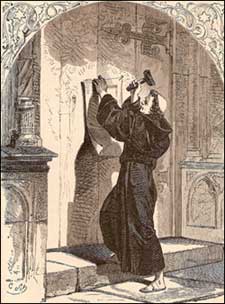
The Reformation, as nearly anybody would tell you, began in 1517 when Martin Luther nailed his ninety-five theses to the door of Wittenberg Chapel in Germany. If I were to give you the whole backstory leading up to this event, I’d need to start a whole new series. Suffice it to say that Luther and several others began to realize that the one of the reasons the Catholic Church held such a strong cultural hold on the people was the fact that few people any more actually knew what was being taught. All the services—those beautiful masses that we’ve discussed—were in Latin. Any sermons, any scriptures—all Latin. With the spread of the Church across Europe, the large majority of the people who worshiped in the church could not understand a word of what they were told. And if you don’t understand it, you can’t refute it. This allowed corruption and extortion to creep in, and the common parishioner was none the wiser.

In order to combat this corruption, Luther broke away from the Church, translated the scriptures and services into the vernacular, and started teaching the average villager how to understand for himself. He did write a German mass, but he also began to compose and teach simple chorales (a vernacular version of the Latin motet). These were intended for congregation singing, and home devotions, bringing sacred music out of the choir loft and to the people. The texts and melodies were either adaptations of Latin chant, or newly composed by Luther and others in the movement.

John Calvin and his reformation in Switzerland and France produced a generous collection of accessible Psalm settings, and the English quickly followed suit. They dropped the mass all together in favor of a simpler service with anthems in English. There were elaborate versions for trained choirs and special occasions, but the large bulk of the music was sung by the congregation, and required little training. Because music was such a part of devotion for these people, it was the religious reformers that did much of the writing and composing of new pieces for worship. Many of these have become the modern hymns of the Protestant Church.
The other half of this coin is the counter-reformation, or the religious reformation accomplished from within the Catholic Church rather than by breaking away from it. With so much upheaval, the Church leaders realized that things weren’t running as they should, and that it was time to re-evaluate. And here we come to the composer that many consider to be the perfection of Renaissance counterpoint.

Giovanni Pierluigi da Palestrina was born in the 1520’s and lived to the end of the century, working at St. Peter’s Basilica for much of his life. He fine-tuned his counterpoint with such finesse that his sound is like none other. Some of the qualities seen in his work include scoring for 4-6 voices but with each voice utilizing only a very tight-range, eliminating voice crossing. His use of consonance and dissonance was very delicate, with enough dissonance to create a satisfying resolution but keeping the imperfect consonances on the strong beats. This practice went a long way in training the public to hear pieces in either the major or minor keys, leaving behind some of the earlier modes. His rhythm flows easily, not obscuring the text, but emphasizing it. One other strong characteristic includes the elimination of parallel fifths and octaves. Any theory student will have been beaten over the head with this rule, but listening to the full, rich sound of Palestrina’s compositions proves the point.

His most famous piece, the Pope Marcellus Mass, has because the stuff of legend. It is said that during the Council of Trent—a meeting of church leaders to discuss reforms—nearly banned polyphonic music from the church, citing the focus on elaborate production rather than the text. According to the story, it was Palestrina’s mass that convinced the council that polyphonic music could be uplifting and sacred, not distracting. Listen to it for a minute--or 30--and you’ll see why the Council was so affected by this piece of genius.

He had contemporaries that pushed his rules somewhat. Tomas Luis deVictoria is a Spanish composer who brought an exotic flair to sacred composition without obscuring its use for worship. He was one of the first to being using chromatics (sharps or flats not included in the key) as a way of emphasizing words or intensifying cadences.


And so we see how sacred music began with very simple, text-based compositions intended only to enhance the devotion of the participant. Slowly, the various chants and services became more elaborate as artists explored the possibilities of this new medium. In time, church authorities felt that the meaning of the text was being lost, and the complex sacred motets of the early Renaissance were becoming useless for worship. Now here at the end of the Renaissance, the church—both Catholic and Protestant—has found a way to maintain the beauty and complexity of its music without losing the original purpose.

Next post, we'll look at the craziness that was the end of the Renaissance in the world of secular music, and how it paved the way for the Baroque era of Monteverdi, Corelli, Handel and Bach. 

Saturday, March 15, 2014

Motets to Madrigals: The Shift from Sacred to Secular

As promised in my previous article in this series, there is one more expansion of the troping principle that became more or less the final elaboration of the many forms of chant. If you recall, troping refers to the practice of adding extra notes, or even extra text to a pre-existing chant. This was very important to the Church, as they held the original texts sacred, untouchable. It was perfectly fine to expand upon or embellish the text, but in no way could you remove the original content.

Before the 13th century, there was polyphonic (multi-voiced) music but it was all done by all embellishing original chant melodies, with the original sacred Latin texts. However, as music became more accessible to the common man, somebody decided that they wanted things to get a little more interesting. So, instead of a single text with multiple voices, they set a different text to each voice. Motets were often three-voice compositions, with one chant text, and the others simply contemporary poetry. They even went so far as to mix languages. It was not uncommon to have a sacred Latin text being sung in the tenor voice--the voice closest to the original chant, while the other voices were set with secular, sometimes even bawdy, French poetry.

These were wildly popular and used for both sacred services and secular entertainment. This shift continued in conjunction with the shift in worldviews. Up until this time, the Church had been the center of religious, political and social life for much of the world. But as history moved from the medieval times, or the Dark Ages, into the Renaissance, culture changed. Humanism became an acceptable school of thought, and, as in any major cultural revolution, music was right there in the thick of things.

Sacred music was still necessary, and most popular composers wrote masses for the Church. However, they no longer were bound by the original chant melodies. They would take their own secular songs and recycle the melodies for sacred compositions. Melody and harmony also took on new characteristics. No longer were the perfect consonances--the fifth and the octave--the ideal sound. Instead, the people learned to love the rich sound of thirds and sixths. This was particularly prevalent in music of English composers such at John Dunstable, so much so that a French writer termed this sound "contenance angloise" or, "countenance of the Englishman."

Influential composers from this time of exploration and advancement include Guillaume du Fay, who was an important composer of the Burgundian school of thought in the early 1400s. He wrote mostly sacred music but did not hesitate to steal themes and motives from his secular compositions. Another of his contributions was the idea of a very complex rhythmic continuity in his works. He would take a basic rhythmic idea, and use it throughout a mass in either expanded or compacted versions. This practice is called isorhythm, and became a staple of compositions for next hundred years.

As the century progressed, the focal point of compositional ideas moved from the Burgundian region of France to the northern Europe, known as the Franco-Netherlands school of composition. This included greats such as Johannes Ockeghem from Paris and Josquin des Prez from northern France. These composers wrote complex secular pieces, for the entertainment and enlightenment of the well-educated. The idea that their music was so complicated that only a scholar could understand it become known as musica reservata, or music reserved for those who can appreciate it.

One of the most popular song forms of the day was the madrigal. These were often written in 5 or 6 voices, with popular poetry (often sonnets) as the text. Word painting was one of the characteristics of this style. Melody passages or harmonic ideas were used to reinforce the text. For instance, quick rising passages for a line about a sunrise, or low intense harmonies for despair.

This video gives an example of a madrigal from the mid-1500s, titled "Da le belle contrade d'oriente" by Cipriano de Rore, a native of Flanders. The text of this particular work is a Petrarchian sonnet declaring undying love before a painful farewell.

This style, with its complex rhythms and intricate symbolism became the pinnacle of Renaissance music. It also set the stage for further development as cultures and ideas continued to evolve. Next episode, we will meet of one of the most influential composers of all time. Looking forward to it!

Saturday, January 25, 2014

The Foundations: Early Greek to Early Church

This last week has been a fairly scattered one for me. Between packing up and moving to a new place and the daunting task of trying to find my theory workbook and sheet music in all the boxes, I haven’t had a lot of time to spend meticulously organizing this article.

That said, it’s been a fascinating couple of weeks in MUSC 2290, once I managed to get ahold of the textbook that UPS conveniently misplaced. We started with very early Greek music and have just barely made it past 1000 A.D (or C.E. for those of you who like to be politically correct). As I go, I’ll very likely be throwing some odd terms at you. If you see a word in boldface, you should be able to find its definition pretty close by.

The ancient Greeks were some of the very first to actually notate music. What it looked like at that points was just a normal wall of text (literally, sometimes) with little dashes or triangles over the various syllables to indicate pitch and/or rhythm. The melodies were very simple, and completely monophonic. Until 500 years ago or so, all music was made up of a single line of melody, no harmonies and definitely not more than one moving part.

One very unique thing about this early music was that it more than likely included quarter-tones. For those of us who have been struggling for years to get half steps and whole steps in tune, can you imagine having an even smaller interval to fine tune! This is also the point in history when writers began dividing music into modes. In modern western music, we only have 2 common modes, the major scale and the minor scale. But in the early Greek and Roman music, there were over a dozen.


Not all modes are created equal, however! Philosophers of the day had very strong opinions about which modes made you lazy, which ones inspired warfare, and which ones were only suited for children. I guess this was the beginning of music genre racism?

As the early church organized and became a larger part of the culture, it also became the catalyst for the evolution of music. By 600 A.D., Pope Gregory was in charge, and although he did not actually compose any music, his consolidation and codification of the church music gave rise to the term Gregorian Chant. At this point, the number of modes had dwindled down to 8, in pairs of 2. Each mode covered a single octave, and had a specific final and dominant. The final referred to the cadential tone, or the note used to finish a piece written in that particular mode. Dominant, in this case, isn't linked to the dominant chord function. Instead, it's the main note that the chant revolves around.

One of the reasons that early music was so simple was because of the fact that it was mostly a setting for religious text. The church believed that the text was supreme, and any elaborate accompaniment would be a distraction. St. Augustine even included this discussion in his famous Confessions. He praised the music for stirring up greater feelings of devotion but lamented the fact that if the music was particularly pleasing, it took his mind away from the subject matter.

                                                                                         Image credit: www.mscperu.org
This is also the reason that instruments were forbidden for church music. However, although there is no record that instruments were ever used in services, we have reason to believe that it was actually quite common. What we do have records of is more than a few edicts censoring the use of instruments. Somebody had to have been breaking the law for it to have been restated so often!

Most of the early chants were melismatic. This means that they were actually very short texts set to long meandering melodies. Certain syllables of the words were drawn out over sometimes a dozen notes. The perfect example of this is the Kyrie. The text was as follows: "Kyrie eleison, Christe eleison, Kyrie eleison." (Lord, have mercy; Christ, have mercy; Lord, have mercy.) This short prayer would be set to any number of longer chant melodies. 

These chants were mostly step-wise, with maybe 1 or 2 jumps of a 4th or a 5th in the whole song. These rules persisted for quite a long time. Notation was at first similar to the Greek method, with symbols placed over the text. These days, they're often seen in a 4 staff notation cobbled together from several various medieval notation styles. The Kyrie is an example of this notation.

Eventually, the monks and congregations got tired of singing Ky-ri-e---------------, and decided that it was time to make the texts more interesting. That however, is a story for another day. As always, if you have questions or input, or something you'd like to hear more about, send us a message or leave a comment! Don't forget--the contest is still running. Read about it here! Faith, signing off.