Showing posts with label music history. Show all posts

Saturday, December 13, 2014

Antonio Vivaldi: The Red Priest


I've decided to quit apologizing for the long breaks between posts, as the frequency with which I post an article is about as often as I get a good night's sleep and have a day to sit back and figure out where the heck I am and what the heck I'm doing! That said, finals are bested, the Fall 2014 final grades are in (at least the ones that matter), and I'm flying high for Christmas break. What better time to write about one of the most fascinating Italian Baroque composers, whose music seems to be heard more often at the holiday times anyway. After all, he did write a whole concerto about Winter.

Antonio Vivaldi was a later Baroque composer, born in 1678 to a humble family in Venice. Whether due to the fact that he was a sickly baby, or the fact that there was an unsettling earthquake the day of his birth, the newborn Antonio was baptized immediately and dedicated to the priesthood in the off chance that he survived to adulthood. As a child, he studied violin and composition from his father as well as from the music director at St. Mark's in Venice.

Despite his obvious musical talent, his infant vows were kept, and after 10 years of study, Vivaldi was ordained as a priest in 1703, at the age of 25. He was much more interested in his music than his priestly duties however, and used his continuing poor health (likely severe asthma, based on the symptoms he described in his correspondence) as a bonafide reason to be granted an exemption from performing mass, and other expected activities for a newly ordained priest. However, Vivaldi did not expect to give up public service completely. Shortly after his entry into the priesthood, he became the violin instructor at the Ospedale della Pieta, an "orphanage" for, in most cases, the illegitimate daughters of noblemen, who were unwilling to acknowledge their daughters' parentage but were happy to provide the best support and education for them.

Vivaldi, whose red hair inspired the nickname "The Red Priest," worked with the Ospedale for over 30 years, teaching general music and strings, as well as composing much of the repertoire that the girls played. Later on, he was appointed music director for the entire program. Under his tutelage, the orphanage's orchestra and choir earned international acclaim. This employment justifies the complaint that I have occasionally heard about Vivaldi's work--it's at times very note-y, and seems to play like a technical etude. Well, that's what many of his concertos were. They were written as part of his curriculum for training his young violin students, and often intended as nothing but passage work etudes. The fact that he was able to write etudes which stand alone as respectable solo works is in and of itself a tribute to Vivaldi's genius.

Some of the characteristics of Vivaldi's concertos--the most famous of which by far are the four violin concertos which make up the Four Seasons--are indeed the technical passage work, the abundance of harmonic sequences (most likely included as part of the girls' music theory education), and a descriptive style reminiscent of word painting techniques of early Italian madrigals. These concertos became widely popular throughout Europe and inspired many transcriptions and arrangements.

Although he maintained his position with the orphanage, later in life Vivaldi began to travel more and also gained success in the opera scene, a portion of his work which many musicians today are unfamiliar with. By the end of his career he had published somewhere between 50 and 100 operas, many of which are lost today. Despite his religious training, Vivaldi actually had issues getting some of his works past the censor boards, because of librettos which included cross-dressing and homosexual relationships.

Because of his work with the orphanage, Vivaldi managed to avoid being locked into the patronage system so common in the Baroque period. However, a great part of his income was generated through commission work for private individuals as well as performing for audiences as prestigious as the Pope. As a priest, he never married, although he maintained a close friendship and suspected romantic relationship with a young singer, Anna Giro. Vivaldi protested whenever insinuations were made, and there is really no evidence for or against a liaison between the two.

Antonio Vivaldi, circa 1725
In 1740, the 62 year old composer left Venice permanently with the intent of taking up residence in Vienna, Austria, most likely to work in the court of Emperor Charles VI. who had expressed great interest in his work. Unfortunately, the emperor passed away and Vivaldi had no source of income in the new city. Ill health prevented him from becoming active in the music scene of Vienna, and in the summer of 1741, Antonio Vivaldi passed away and was was given a pauper's funeral without any music.

Much of his fame was forgotten in the following years, and it wasn't until the efforts of performer/composer Fritz Kreisler in the early 1900s that interest in Vivaldi's music was revived. Over 600 of his works have been cataloged, and as of ten years ago, more were still being discovered. Conversely, only 3 portraits of the composer have survived.

Saturday, October 4, 2014

Jean-Baptiste Lully: the Italian Frenchman

Wow! It's been a long time since I've posted, and I'm afraid I've rather forgotten the elaborate plan I had for conquering the Baroque period. Getting married will do that to you. So rather than go into great detail on the technical side of things, we'll look at the lives and works of three major Baroque composers from three different countries: the French composer Jean-Baptiste Lully; the master of the Italian baroque, Antonio Vivaldi; and likely the greatest genius of them all, the German Johann Sebastian Bach. Hopefully this will cover most of the ground needed to properly understand this pivotal period in music history.

Interestingly enough, while Lully is known for being a pioneer of the French baroque style, and especially of French opera, he was actually born Giovanni Battista Lulli, an undeniably Italian name, in the undeniably Italian city of Florence. As a child in a working class family, he picked up enough skill as a dancer and a violinist to earn extra cash as a street entertainer. When he was 14, he caught the eye of a passing French nobleman who had been instructed to visit Italy and bring back a companion for his royal niece, who needed practice with her Italian.

So it came to pass, that in 1646, the boy moved to Paris, and very quickly fell in love with the people and the culture of France. As a court entertainer, Lully had the opportunity to work with the best French composers of the day. It was not long before he began to develop a distaste for the practices and styles of the Italian music of his childhood.

When his employer moved away from the city, 20 year old Lully resigned in order to stay in Paris, making his living by writing and dancing in court ballets. It was one of these performances in which the young dancer impressed the 14 year old Louis XIV, who was to become Lully's lifelong patron. At this point, France was for all practical purposes ruled by the young king's guardian, which left Louis free to pursue entertainment. Ballet and music was one of his passions, and he took an instant liking Lully. It was not long before Lully replaced an older, and much more experienced, Italian composer as Louis XIV's personal music director.

Because the king's guardian was an Italian cardinal, there was considerable Italian influence in Paris at the time, including several productions of Italian opera. Many of the French noblemen did not appreciate this art form, and Lully whole-heartedly agreed. He took it upon himself to collaborate with various French poets and playwrights and create a whole new breed of opera.

These productions were in the French language and moved away from many of the Italian operatic practices. Instead, Lully mixed recitative and aria together, used more natural and predictable poetic forms, and scored his works for a variable ensemble.

In 1661, the year that Louis XIV took over the rule of France upon the death of his guardian, Lully
finally was granted full French citizenship. It was at this point that he changed the spelling of his name to reflect his love for his adopted country. For the next twenty years, Lully produced operas and ballets for the royal court and the people of Paris. He continued to hold considerable influence through his position in court, and was fairly proud of the fact. By 1681 he was signing his works: Monsieur de Lully, escuyer, conseiller, Secrétaire du Roy, Maison, Couronne de France & de ses Finances, & Sur-Intendant de la Musique de sa Majesté. (Don't ask me to translate all that!)

Unfortunately, in 1683 the king grew disenchanted with the entertainment that Lully provided. The new queen brought a much more puritanical air to the court, and Lully's liberal lifestyle choices were suddenly not nearly as acceptable as they had been previously. He retained his position at court but lost some of his friendship with the king.

Sadly, it was also his career that indirectly ended his life in 1687. As a baroque conductor, he did not use a baton but instead a staff which he thumped on the ground to keep the group together (similar to a middle school orchestra director banging his pen on the stand). Unfortunately, when Lully was conducting a piece in celebration of Louis XIV recovery from surgery, he impaled his own foot with the end of the staff. Whether this came about through carelessness or a little bit of pouting, it didn't end well... his foot developed gangrene and he died shortly afterwards from complications.


Despite his undignified exit from this world, Lully did much for the musical world of France during his life time. He brought liveliness and attitude to instrumental works, and made the whole genre of opera accessible to his country. He also introduced the French overture style, which carried over into much of baroque and classical music, French or otherwise. Even Beethoven used it to open his Pathetique sonata. This particular style was a slow, stately march in duple time, often used an an introduction or overture to a larger work. It is characterized by frequent dotted rhythms in the melody and thick, chordal accompaniment.

A classic example of Lully's French Overture style is the overture to his 1670 collaboration with  French playwright Moliere. La Bourgeois Gentilhomme is a comedie-ballet, or the French version of the ballad opera. The premier of this work boasted a start-studded cast, including both Moliere and Lully playing roles.

Monday, May 19, 2014

Baroque Beginnings

The last couple of weeks have been full of travelling (Adam), wedding planning (me) and other sundry life happenings that tend to sneak up behind you and trip you when you're not looking (also me). But I'm back for now, and have some interesting topics to get to work on.

In last couple posts in this series, we tied up the Renaissance period of music history, both in the secular and sacred genres. As we move into the Baroque, there is less distinction between the two, and they progress in basically the same direction, so you'll be hearing a lot less about the dichotomy between sacred and secular.

First off, let's examine the term "baroque." Today, it is simply used to describe various styles developed in the arts between 1600-1750(ish). However, it was originally applied to the time period as an epithet by 19th-century art critics, implying that one was wrinkling one's proper classical nose at the gaudy, overly ornamented style of visual art or music prevalent during this period in history. But, as I have been reminded three times in the past couple months by three different history professors, art history is not a linear progression: we are not moving from good to better to best. Each time period had its strengths and weaknesses, and those classical critics would have done well to remember that. Either way, "baroque" is no longer considered a derogatory term and you can use it safely without be arrested by the Politically Correct Police. (Such an organization exists, trust me. Especially on Facebook. They're kind of like the Grammar Nazis.)

If you recall, the Renaissance period finished with a bang, full of crazy dissonance, over-the-top dramatics, and elaborate text painting. Towards the end of the period, there was a group of intellectuals who called themselves the Florentine Camerata (Florence Club) that met regularly to discuss the state of the world, and more specifically that of the arts. One of them, Vincenzo Galilei (father of the more famous Galileo Galilei of gravity and heliocentrism), write a fairly complex treatise on the reasons why the popular music of the day was not as effective as the ancient musics. He also added his two-cents on how music should change for the betterment of society rather than its amusement.

He said a lot of things in this work, a lot of them not very complementary to the current state of the arts, but one of his main arguments was that music should be used to better the state of society rather that simply to amuse or please our senses. Galilei felt that the popular style of text painting was useless in that regard, as it only described what was occurring in the text and did nothing to incite an actual change of heart in the listener. He also argued that the thick polyphonic textures were so complex that they were a distraction from any single purpose. His solution to this problem was for composers and musicians to consider themselves actors or even lawyers, so to speak. Music could be used as language, to convince the listeners to take on a certain "affect" or, state of being.

This led, naturally, to a change in styles. Instead of focusing strongly on contrapuntal textures, Galilei argued for the use of monody, or compositions made up of one primary voice with harmonic accompaniment. This would bridge the gap between single line chants of the very ancient times and the multi-voiced polyphonic works of more recent styles.

Galilei's intellectual theories sparked a radical change in compositional practice, leading to the birth of the ubiquitous basso continuo line that persisted throughout the Baroque period and even somewhat into the Classical (Beethoven himself included a continuo line with figured bass in a few of his compositions). However, I've spent so much time talking about the theory that practice will have to wait till the next post. When that time comes, I'll start by defining the whole basso continuo idea, and then we'll move on to some of the seminal composers of the period.

Saturday, April 26, 2014

The Mannerism of Madrigalisms

In my last article in the series (somewhere around a month ago--apologies for the long wait!), I outlined the trends of sacred music at the end of the Renaissance. This included moving away from the elaborate productions of mid-Renaissance style, and returning to the simpler, more text-focused music for liturgical purposes.

Secular music, on the other hand, felt no such need. In fact, it just got crazier.

Mannerism is a generic term, not restricted to music at all, and in fact is more often used to describe visual art. Nevertheless, it is the perfect term to describe what happened with secular music at the end of the Renaissance, around 1560-1600. According to Webster's dictionary, mannerism is defined as follows: 


a :  exaggerated or affected adherence to a particular style 
                           b  :  an art style in late 16th century Europe characterized by spatial incongruity and excessive elongation of the human figures


In other words, taking a style to such an extreme that before long, people will grow sick of it and move away from that that style for good. This is exactly what happened with both art and music at the end of the 16th century. Here is a painting by one of the most famous Mannerist painters, El Greco (1541-1614). As you can see, the proportions are a little funky, the colors are vivid, and the emotions are intense and obvious. Mannerist art can get a little overwhelming, but it achieves its purpose nicely. By the time you get done studying this picture, you'll have a very a clear idea of what the artist wanted you to think or feel. 

The exact same thing happened with secular music. Composers were already writing madrigals, and, as we discussed a while ago, one of the characteristics of the madrigal was word painting. By the end of the 1500s, word painting, through either melody or harmony, was taken to such an extreme, and was so married to the genre that the technique became known as madrigalisms. 

Madrigalisms included frequent and unusual use of chromaticism, sometimes abandoning what sense of key signature music had developed by this point. One type of chromatic harmony that was particularly unique in that time period was the cross-relation. This referred to a note played in both its natural and its sharp or flatted version at the same time, or in very quick succession. For instance, a five voice madrigal might have the soprano line singing a C sharp at the same time the second tenor is singing a C natural. This type of dissonance is perfect for expressing the intense emotions desired by the Mannerist composers such as Carlos Gesualdo or Cipriano de Rore.

Another choice by composers of late Renaissance madrigals rather than ones earlier in the century was the type of text. Earlier compositions included literary poetry such as sonnets, and the text was always chosen for its sophistication and quality. By the end of the period, texts were chosen for their emotional content, and, if looked at critically, could even come across as slightly manic or unstable. However, once again, they were perfect for the effect.

This madrigal by Gesualdo is one of my examples of the Mannerism in composition. If you take a moment to follow along in the score, you will see the extensive chromaticism and non-diatonic harmonies. A small portion of the text reads:
"I depart." I said no more, for grief
robbed my heart of life...
"Hence in pain I remain, Ah may I never
cease to pine away in sad laments."

Crazy, huh? By the early 1600s, this style had been done to death, and people were ready for a change. Enter... the Baroque! Which we will discuss next time, because I have to get ready to play for an opera. 

Oh, by the way... if you're interested, there's a 7:30 pm show on Saturday, April 26 and a 2pm show on Sunday April 27 of Hansel and Gretel, an opera that's actually in English, and has some pretty fun moments. It's in Robinson Hall at UNC Charlotte, and really would be worth it. Even if you don't like opera. Would love to see you there!

Sunday, April 13, 2014

Alessandro Scarlatti: Supreme Musical Innovator

Ok, folks, due to prepping for sophmore review, superjuries, end of semester projects, and exams, my brain is complete mush this weekend, and I really don't want to subject you to reading brain mush. So, in lieu of writing the next post in our music history series, I shall make a brief digression and instead present to you a portion of said end-of-semester project for my music history course. Please enjoy a condensed biography of the great Baroque composer Alessandro Scarlatti. 


Pietro Alessandro Gaspare Scarlatti is one of the most influential composers of the Italian Baroque period. Scarlatti wrote extensively for the musical theatres of his day: cantatas, serenatas, and of course dozens of full length operas, the genre in which his influence is most recognized. Church music also makes up a good portion of his works, in the form of oratorios and masses. Later in his life, Scarlatti touched on instrumental music, although little survives, and seems to be merely diversionary rather than a primary focus. He left this type of composition to his famous son Domenico. Spending his life rotating between several major Italian cities—Rome, Venice and Naples—and patronized by such kingpins as the Medici family, Scarlatti was able to spread his influence through many outlets and raise the bar for both opera specifically and general compositional practice for the rest of the world.


Scarlatti was born in 1660, in the heart of the Baroque period, to a family already primed to produce great musicians. His father Pietro was a singer, and four of his six siblings were also professional musicians. Scarlatti would go on to continue the tradition, with the composer Domenico Scarlatti as his most famous son, as well as two other children earning their own respect as performers. His family moved to Rome when he was 12, and he married into high society in 1678. Nothing is known of his early musical training, but such training obviously took place, for his first opera, Gli equivovi nel sembiante, was produced shortly before his 19th birthday. There is some speculation that Scarlatti may have trained under Roman composer Carissimi, who passed away when Scarlatti was in his teens. This speculation is mostly based on the strong influence of Carissimi’s style seen in Scarlatti’s early work.

The success of this first opera threw Scarlatti into the notice of many of the aristocracy of Rome as well as the fairly international audience of Roman courts and ambassadors. Before long, he was appointed maestro di capella, or choirmaster, for the court of the mysterious Queen Christina of Sweden, a noblewoman estranged from her home country upon conversion to Catholicism. She supported Scarlatti in his work as he continued to write and produce operas. He was in some disfavor with the Church at this point for two reasons. First, opera was a controversial subject at the time, with edicts from as high up as the Vatican condemning it as indecent and liberal. There was also some outcry when Scarlatti’s secular musicians were brought in for church performances. The second reason was that Scarlatti’s sister Anna, a popular singer, was accused of inappropriate behavior with more than one church official. Despite these issues, at least two cardinals commissioned oratorios from Scarlatti for Lenten services.

Fame did not keep Scarlatti in Rome for very long, however. Shortly after he produced his wildly popular opera, Il Pompeo, he moved his family to Naples, the city which would become his favorite and eventually the home of his old age. The next 18 years were spent here, writing operas and oratorios, as well as sacred works and chamber cantatas for private performance. It was during this period that Scarlatti began to develop his own unique opera style which in turn would become the prescription for other composers of the genre to follow. Characteristics of Scarlatti’s operas include arias in ternary form, very little music independent of the texts, and the lowered importance of the chorus. Although operas such as La Rosaura and Pirro e Demetrio received most acclaim, some modern scholars feel that his chamber cantatas were the outlet for “the most profound of his musical ideas.”

It was also in Naples that Scarlatti received the patronage of Ferdinando de Medici, and celebrated the birth of several of his children, including Domenico. He even wrote and directed a serenata for the visit of King Phillip V of Spain, a celebration in which his rival, Corelli, also participated but received less than favorable reviews. The serenta, Venere, Adone, et Amore, was composed near the end of his time in Naples, in 1696. The occasion was an annual summertime festival in Naples with the guest of honor being a newly appointed Spanish viceroy, well known to be a patron of the arts. Scarlatti turned out at least two other popular serenatas this same year, working with the poet Francesco Paglia.

In 1702, he visited the Medici family in Florence, but did not find the success he was looking for, and returned to Rome. For the next 20 years, Scarlatti, along with his son Domenico, moved from city to city, searching for the elusive position which would provide both artistic satisfaction and financial stability. While this period was in general a very disappointing era of Scarlatti’s life, there were a few high points. In 1706, he was inducted into the Arcadian Academy, a sort of literary honor society originally formed by Scarlatti’s old patron, Queen Christina. The year after, Il Mitridate Eupatore, one of his most acclaimed operas, was performed in Venice.

In 1722, Scarlatti left Domenico, who was now earning respect as a composer in his own right, in Rome and retired to Naples to live in relative poverty until his death in 1725. Although his later years brought him fewer public accolades than his early successes, there were still those who appreciated his genius. One Neapolitan newspaper stated that “as [Scarlatti] increases in age, so all the more does he acquire new and sublime ideas in his compositions.” His tombstone, with an epitaph written by Cardinal Ottoboni, longtime collaborator with Scarlatti, sums it all up with the title of Musices Instaurator Maximus, or, Supreme Musical Innovator.

Saturday, March 29, 2014

Reformation and Counter-Reformation: Why We Don't All Sing in Latin Anymore


In the previous installment of this series, we concluded with a discussion of the madrigal and how it, in some ways, was the best example of Renaissance style. The very end of the Renaissance, however, brought about some very interesting developments. As history continued to march on, with political, social and religious change, music was right there in the middle of it. There were two topics I was hoping to cover today, but as I wrote the body of the article, I realized that they are each so important to the history and development of music as we know it, that they deserve their own posts. Today, we’ll look at the music of the Reformation and Counter-reformation, the influential composers of this phenomenon, and how sacred music had to some extent come full circle. The second idea, which we’ll explore in a couple weeks—is how secular composers followed the trends of the other arts—visual and language arts—by showing extreme mannerism in their styles.

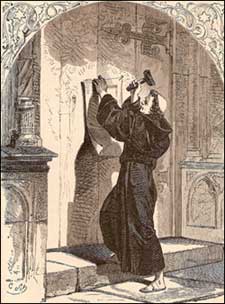
The Reformation, as nearly anybody would tell you, began in 1517 when Martin Luther nailed his ninety-five theses to the door of Wittenberg Chapel in Germany. If I were to give you the whole backstory leading up to this event, I’d need to start a whole new series. Suffice it to say that Luther and several others began to realize that the one of the reasons the Catholic Church held such a strong cultural hold on the people was the fact that few people any more actually knew what was being taught. All the services—those beautiful masses that we’ve discussed—were in Latin. Any sermons, any scriptures—all Latin. With the spread of the Church across Europe, the large majority of the people who worshiped in the church could not understand a word of what they were told. And if you don’t understand it, you can’t refute it. This allowed corruption and extortion to creep in, and the common parishioner was none the wiser.

In order to combat this corruption, Luther broke away from the Church, translated the scriptures and services into the vernacular, and started teaching the average villager how to understand for himself. He did write a German mass, but he also began to compose and teach simple chorales (a vernacular version of the Latin motet). These were intended for congregation singing, and home devotions, bringing sacred music out of the choir loft and to the people. The texts and melodies were either adaptations of Latin chant, or newly composed by Luther and others in the movement.

John Calvin and his reformation in Switzerland and France produced a generous collection of accessible Psalm settings, and the English quickly followed suit. They dropped the mass all together in favor of a simpler service with anthems in English. There were elaborate versions for trained choirs and special occasions, but the large bulk of the music was sung by the congregation, and required little training. Because music was such a part of devotion for these people, it was the religious reformers that did much of the writing and composing of new pieces for worship. Many of these have become the modern hymns of the Protestant Church.
The other half of this coin is the counter-reformation, or the religious reformation accomplished from within the Catholic Church rather than by breaking away from it. With so much upheaval, the Church leaders realized that things weren’t running as they should, and that it was time to re-evaluate. And here we come to the composer that many consider to be the perfection of Renaissance counterpoint.

Giovanni Pierluigi da Palestrina was born in the 1520’s and lived to the end of the century, working at St. Peter’s Basilica for much of his life. He fine-tuned his counterpoint with such finesse that his sound is like none other. Some of the qualities seen in his work include scoring for 4-6 voices but with each voice utilizing only a very tight-range, eliminating voice crossing. His use of consonance and dissonance was very delicate, with enough dissonance to create a satisfying resolution but keeping the imperfect consonances on the strong beats. This practice went a long way in training the public to hear pieces in either the major or minor keys, leaving behind some of the earlier modes. His rhythm flows easily, not obscuring the text, but emphasizing it. One other strong characteristic includes the elimination of parallel fifths and octaves. Any theory student will have been beaten over the head with this rule, but listening to the full, rich sound of Palestrina’s compositions proves the point.

His most famous piece, the Pope Marcellus Mass, has because the stuff of legend. It is said that during the Council of Trent—a meeting of church leaders to discuss reforms—nearly banned polyphonic music from the church, citing the focus on elaborate production rather than the text. According to the story, it was Palestrina’s mass that convinced the council that polyphonic music could be uplifting and sacred, not distracting. Listen to it for a minute--or 30--and you’ll see why the Council was so affected by this piece of genius.

He had contemporaries that pushed his rules somewhat. Tomas Luis deVictoria is a Spanish composer who brought an exotic flair to sacred composition without obscuring its use for worship. He was one of the first to being using chromatics (sharps or flats not included in the key) as a way of emphasizing words or intensifying cadences.


And so we see how sacred music began with very simple, text-based compositions intended only to enhance the devotion of the participant. Slowly, the various chants and services became more elaborate as artists explored the possibilities of this new medium. In time, church authorities felt that the meaning of the text was being lost, and the complex sacred motets of the early Renaissance were becoming useless for worship. Now here at the end of the Renaissance, the church—both Catholic and Protestant—has found a way to maintain the beauty and complexity of its music without losing the original purpose.

Next post, we'll look at the craziness that was the end of the Renaissance in the world of secular music, and how it paved the way for the Baroque era of Monteverdi, Corelli, Handel and Bach. 

Saturday, March 15, 2014

Motets to Madrigals: The Shift from Sacred to Secular

As promised in my previous article in this series, there is one more expansion of the troping principle that became more or less the final elaboration of the many forms of chant. If you recall, troping refers to the practice of adding extra notes, or even extra text to a pre-existing chant. This was very important to the Church, as they held the original texts sacred, untouchable. It was perfectly fine to expand upon or embellish the text, but in no way could you remove the original content.

Before the 13th century, there was polyphonic (multi-voiced) music but it was all done by all embellishing original chant melodies, with the original sacred Latin texts. However, as music became more accessible to the common man, somebody decided that they wanted things to get a little more interesting. So, instead of a single text with multiple voices, they set a different text to each voice. Motets were often three-voice compositions, with one chant text, and the others simply contemporary poetry. They even went so far as to mix languages. It was not uncommon to have a sacred Latin text being sung in the tenor voice--the voice closest to the original chant, while the other voices were set with secular, sometimes even bawdy, French poetry.

These were wildly popular and used for both sacred services and secular entertainment. This shift continued in conjunction with the shift in worldviews. Up until this time, the Church had been the center of religious, political and social life for much of the world. But as history moved from the medieval times, or the Dark Ages, into the Renaissance, culture changed. Humanism became an acceptable school of thought, and, as in any major cultural revolution, music was right there in the thick of things.

Sacred music was still necessary, and most popular composers wrote masses for the Church. However, they no longer were bound by the original chant melodies. They would take their own secular songs and recycle the melodies for sacred compositions. Melody and harmony also took on new characteristics. No longer were the perfect consonances--the fifth and the octave--the ideal sound. Instead, the people learned to love the rich sound of thirds and sixths. This was particularly prevalent in music of English composers such at John Dunstable, so much so that a French writer termed this sound "contenance angloise" or, "countenance of the Englishman."

Influential composers from this time of exploration and advancement include Guillaume du Fay, who was an important composer of the Burgundian school of thought in the early 1400s. He wrote mostly sacred music but did not hesitate to steal themes and motives from his secular compositions. Another of his contributions was the idea of a very complex rhythmic continuity in his works. He would take a basic rhythmic idea, and use it throughout a mass in either expanded or compacted versions. This practice is called isorhythm, and became a staple of compositions for next hundred years.

As the century progressed, the focal point of compositional ideas moved from the Burgundian region of France to the northern Europe, known as the Franco-Netherlands school of composition. This included greats such as Johannes Ockeghem from Paris and Josquin des Prez from northern France. These composers wrote complex secular pieces, for the entertainment and enlightenment of the well-educated. The idea that their music was so complicated that only a scholar could understand it become known as musica reservata, or music reserved for those who can appreciate it.

One of the most popular song forms of the day was the madrigal. These were often written in 5 or 6 voices, with popular poetry (often sonnets) as the text. Word painting was one of the characteristics of this style. Melody passages or harmonic ideas were used to reinforce the text. For instance, quick rising passages for a line about a sunrise, or low intense harmonies for despair.

This video gives an example of a madrigal from the mid-1500s, titled "Da le belle contrade d'oriente" by Cipriano de Rore, a native of Flanders. The text of this particular work is a Petrarchian sonnet declaring undying love before a painful farewell.

This style, with its complex rhythms and intricate symbolism became the pinnacle of Renaissance music. It also set the stage for further development as cultures and ideas continued to evolve. Next episode, we will meet of one of the most influential composers of all time. Looking forward to it!

Saturday, February 8, 2014

The Many Uses of Troping

Last we left them, the monks were ready to try something new. Very short texts set to very long chants were rather difficult to memorize. One fellow in particular, a monk named Notker the Stammerer who lived in the Abby of St. Gall around 800 A.D, just couldn't manage to remember the Alleluias. So, in order to help him remember the long melodic passages, he wrote a poem to match the melody. If every note had its own syllable, it was much easier to memorize. Then, when it was time to sing the liturgy, all he had to do was drop the words and replace them with "Al-le-lu-ia-----------"

Funny enough, other people liked the idea. They didn't just use his poems for practice and memory work. They started singing them along as part of the service. And so troping was born. This practice--adding to or expanding an existing chant--became extremely popular and saw many variations over the next 400 or so years.

See, in the church music scene in the early years, the original liturgical text was sacred. Paramount, untouchable, sacred. You couldn't get rid of it. You couldn't change it. But there was a catch--you could expand it, add stuff around or on top it, and pretty much do whatever you wanted, as long as the original text could still be found in there somewhere. So troping was the perfect technique as musicians began to expand their horizons.

It was also around this time that musical theatre was born. Liturgical dramas were staged for special days, such as Christmas or Easter. Most of the text was straight from Biblical accounts, but there were elaborate stage directions included in the manuscripts. This art form slowly evolved away from the liturgy and the church, and moved to the towns and villages. As did music.

By the time the new millennium had rung itself in, a group of monk school dropouts had formed and called themselves the Goliards.  They traveled around doing what most college students do--drinking, partying, and finding girls to join them. And because they were at least partially educated in the monasteries, they could write and they could sing. By the 1200s, there was at least one manuscript of secular Latin songs. Some were course, some were poetic, and some tried to be at least a little bit moral.

Of course the trend spread, giving rise to the troubadours of southern France, the trouveres of northern France, the minstrals of England and the minnesingers of Germany. They all wrote and sang about pretty much the same things: wine, women, and war. Like as not, they accompanied themselves on instruments such as early forms of the violin, the recorder and of course percussion.

The church still did its best to keep instruments out of the services. This didn't stop them from experimenting with new ways to expand their music without losing the foundation of the chant. About the same time secular music was on its rise, somebody came up with the novel idea of two groups singing at the same time, called organum. It started out very simple--two voices singing the same old chant, but one moving completely parallel to the first at a fourth or fifth below. Then they learned how to move in contrary motion but avoid any nasty intervals. Mostly consonances were used--unison, octave, fifth and fourth, with a couple sixths or thirds thrown in at the cadences.

Slowly but surely, the musicians became comfortable singing different rhythms simultaeously. The choir would sing the original chant with its original melody, while the soloist improvised the organum voice with a separate rhythm on top of the cantus firmus (fixed song). The next obvious step was adding more voices. Some chants had up to four. These upper parts were rarely written out. Instead, they were improvised following a very specific set of rules laid out in a grand treatise written around 1100 A.D.--"Ad Organum Faciendum" Or, On Making Organum.

There were two specific types of organum, and each was paired to a specific type of chant. Each note of the very long, melismatic passages in the original chant corrosponded to maybe two or three notes of organum. This was called discant organum. The simpler, long tones of a chant would be set to more melismatic organum parts, called florid organum. Leonin, who worked at the Cathedral of Notre Dame, collected a book of transcribed organum parts, and aptly titled it "The Big Book of Organum." This particular chant comes from Leonin's anthology.

http://www.youtube.com/watch?v=bganS0KBsEY


So it happened, that without even realizing it, polyphony--music with more than one voice--was born, evolved and gradually became the accepted method of composition. There was one more development to the chant, one more application of troping, that we will discuss next time. So make sure to come back in a couple weeks and check it out!

On a completely separate note, if you live anywhere near the UNC Charlotte campus, and have nothing to do on Thursday, February 13th, you might consider coming to hear me play in the UNCC Chamber Orchestra concert at 7:30 in Rowe Recital Hall. Admission is free, and it will be a pretty awesome program--Beethoven, Lully and Finzi (with an amazing tenor solo by the esteemed Dr. Brian Areola). Need details? Just ask!

Saturday, January 25, 2014

The Foundations: Early Greek to Early Church

This last week has been a fairly scattered one for me. Between packing up and moving to a new place and the daunting task of trying to find my theory workbook and sheet music in all the boxes, I haven’t had a lot of time to spend meticulously organizing this article.

That said, it’s been a fascinating couple of weeks in MUSC 2290, once I managed to get ahold of the textbook that UPS conveniently misplaced. We started with very early Greek music and have just barely made it past 1000 A.D (or C.E. for those of you who like to be politically correct). As I go, I’ll very likely be throwing some odd terms at you. If you see a word in boldface, you should be able to find its definition pretty close by.

The ancient Greeks were some of the very first to actually notate music. What it looked like at that points was just a normal wall of text (literally, sometimes) with little dashes or triangles over the various syllables to indicate pitch and/or rhythm. The melodies were very simple, and completely monophonic. Until 500 years ago or so, all music was made up of a single line of melody, no harmonies and definitely not more than one moving part.

One very unique thing about this early music was that it more than likely included quarter-tones. For those of us who have been struggling for years to get half steps and whole steps in tune, can you imagine having an even smaller interval to fine tune! This is also the point in history when writers began dividing music into modes. In modern western music, we only have 2 common modes, the major scale and the minor scale. But in the early Greek and Roman music, there were over a dozen.


Not all modes are created equal, however! Philosophers of the day had very strong opinions about which modes made you lazy, which ones inspired warfare, and which ones were only suited for children. I guess this was the beginning of music genre racism?

As the early church organized and became a larger part of the culture, it also became the catalyst for the evolution of music. By 600 A.D., Pope Gregory was in charge, and although he did not actually compose any music, his consolidation and codification of the church music gave rise to the term Gregorian Chant. At this point, the number of modes had dwindled down to 8, in pairs of 2. Each mode covered a single octave, and had a specific final and dominant. The final referred to the cadential tone, or the note used to finish a piece written in that particular mode. Dominant, in this case, isn't linked to the dominant chord function. Instead, it's the main note that the chant revolves around.

One of the reasons that early music was so simple was because of the fact that it was mostly a setting for religious text. The church believed that the text was supreme, and any elaborate accompaniment would be a distraction. St. Augustine even included this discussion in his famous Confessions. He praised the music for stirring up greater feelings of devotion but lamented the fact that if the music was particularly pleasing, it took his mind away from the subject matter.

                                                                                         Image credit: www.mscperu.org
This is also the reason that instruments were forbidden for church music. However, although there is no record that instruments were ever used in services, we have reason to believe that it was actually quite common. What we do have records of is more than a few edicts censoring the use of instruments. Somebody had to have been breaking the law for it to have been restated so often!

Most of the early chants were melismatic. This means that they were actually very short texts set to long meandering melodies. Certain syllables of the words were drawn out over sometimes a dozen notes. The perfect example of this is the Kyrie. The text was as follows: "Kyrie eleison, Christe eleison, Kyrie eleison." (Lord, have mercy; Christ, have mercy; Lord, have mercy.) This short prayer would be set to any number of longer chant melodies. 

These chants were mostly step-wise, with maybe 1 or 2 jumps of a 4th or a 5th in the whole song. These rules persisted for quite a long time. Notation was at first similar to the Greek method, with symbols placed over the text. These days, they're often seen in a 4 staff notation cobbled together from several various medieval notation styles. The Kyrie is an example of this notation.

Eventually, the monks and congregations got tired of singing Ky-ri-e---------------, and decided that it was time to make the texts more interesting. That however, is a story for another day. As always, if you have questions or input, or something you'd like to hear more about, send us a message or leave a comment! Don't forget--the contest is still running. Read about it here! Faith, signing off. 

Saturday, January 11, 2014

From Monks to Metal: A condensed history of western music

Well, maybe not quite as far as metal. That’s a story for another day, and probably another writer. But we are going to start with monks. When Sulli asked me to think of a series, we spent a couple of late night hours trying to brainstorm and getting nowhere. Then I looked to my upcoming class schedule for inspiration. Theory IV... not a good place to start. Aural Skills IV? Can't exactly teach solfege in a blog post. Class Piano and Recital Class are completely off the table. Then it hit me. Starting next week, I’m beginning a 3 semester journey through the history of western music. And before somebody starts to freak out and think and I’m talking about country-western, this term refers mostly to European sacred and art music from the common practice period (roughly 1550-1900). 
I love history, I love music... and its a subject that would be fairly easy to translate into something fun to read while still being useful and information. So here you have it. This is the first post in a series that could potentially last a year and a half.
The foundation for this type of music was laid in the church music tradition dating back to the inception of organized Christianity. Our studies will take us from the early church modes moving through the Baroque, Classical and Romantic periods to the Contemporary styles. We may even touch on some of the post-modernistic writing going on today.
Every two weeks, I will take what I have learned and condense it into a post for you all. By time it’s finished you and I (hopefully) should be able to ace any college level music history exam. That being said, today’s post will be fairly short for two reasons. First, because this is only an introduction to the series and second, because I haven’t actually learned anything in my class yet. Unless of course you count course policy and evacuation procedures.
                So what exactly are we going to be learning? Yes, there will be birth place and death dates of the important composers for each period, but that’s not really going to be the focus. Instead, we will discuss the melodic and harmonic rules of western music, and how they are added to, modified, or scratched completely as music has developed over the last 500 years or so. There will probably be a discussion of Johann Fux’s rules for counterpoint that he wrote down in the early 1700s (and don’t worry, it’s pronounced ‘fooks’), and of course the various church modes that date back to the 600s A.D.

                We’ll also find out why old chants sound mysterious and Romantic music sounds… well, romantic, and what it was about Stravinsky’s “Rite of Spring” that was so revolutionary that its first performance included a riot started by offended concert goers. Also, we’ll see how events and trends in history were reflected in the music of the day, and sometimes even vice versa. And of course, there will be a discussion of compositional forms and their conventions and unconventional digressions.
                If none of that means anything to you, don't worry! I'll do my best to make it as user friendly as possible. And if you have questions, or want to know more about a certain subject, well that's what the comment section is for! Glad to have you along for the ride.