Hello everyone and welcome back to the next episode of Music
Theory 101. Sorry about vanishing, but between the end of school, the trip/
meeting in Minneapolis and then getting two major plans set up (announcements ASAP)
I literally had no time to keep working. This will be the end of the explanations
and salutations though because we have a month’s worth of material to make up in
this extended post!
~Amplitude
~Dynamics
~Forte and Piano
~Mezzo
~Adding -issimo (fortissimo, pianissimo)
~Fortepiano and Pianoforte
Catching everyone back up to speed, we have gone through
posting about the basics of music and have made our way through two of the six:
Pitch and Rhythm. This time, we move onward to the next topic for discussion;
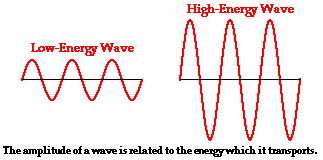
dynamics. Dynamics are the musical equivalent to amplitude. For those in need
of a quick refresher, amplitude is the expansion or contraction of the wave’s
height causes the wave to have more or less force. This increase or decrease in
power can cause our ears to perceive what we hear to be louder or softer. That’s
honestly all there is to this one in terms of science and terminology. However,
dynamics play a more important role in music.
 Music’s emotional weight is primarily built off of dynamic
control. It is true to the point of listening to movies. Think to the last
movie you’ve seen and how the dynamics of the music played into each point that
the scene was trying to make. For example, whenever there is a romantic scene
and there is a couple talking, the music backs off but you can hear
that they are playing. Once they start to kiss, the music becomes really loud to show that
emotion’s weight. The same can be argued for any kind of music. A classical
example is “March of the Scaffolds” by Hector Berlioz. The beginning starts out
low and quiet until the cellos and bass come in with the motif of the movement.
Every time there is portrayed a horrifying moment or a moment of triumph in the
movement then the horns play loud. Whenever the thought of his beloved come to
him, then it is soft and tender. Modern music examples is the difference between
a rock ballad and heavy metal. The difference between trance/chillstep and hard
style/brostep. Dynamics control a lot in music.
Music’s emotional weight is primarily built off of dynamic
control. It is true to the point of listening to movies. Think to the last
movie you’ve seen and how the dynamics of the music played into each point that
the scene was trying to make. For example, whenever there is a romantic scene
and there is a couple talking, the music backs off but you can hear
that they are playing. Once they start to kiss, the music becomes really loud to show that
emotion’s weight. The same can be argued for any kind of music. A classical
example is “March of the Scaffolds” by Hector Berlioz. The beginning starts out
low and quiet until the cellos and bass come in with the motif of the movement.
Every time there is portrayed a horrifying moment or a moment of triumph in the
movement then the horns play loud. Whenever the thought of his beloved come to
him, then it is soft and tender. Modern music examples is the difference between
a rock ballad and heavy metal. The difference between trance/chillstep and hard
style/brostep. Dynamics control a lot in music.
Now that we know what it is and what they do, why not
explain how they are in music. Before we begin however, it should be noted that
they are very situational. None are defined by an absolute “loudness” like pitch
and other things in music. Dynamics are based off their original words in Italian
and use the first letter to represent the dynamic. Forte is considered to be “loud”
and is shown by adding an italicized f.
Piano is considered “soft” or quiet and is shown with an italicized p. Next thing to know about with
dynamics is the mezzo range. Mezzo means medium and if it’s used as a prefix,
it means either medium loud, mezzo forte or mf,
or medium soft, mezzo piano or mp.

There are also extremes by adding more of each letter into
the mix, getting fortissimo, ff and
pianissimo, pp. When you add the -ssimo suffix; meaning very, you can create more extremes for your dynamic timeline. You can add more
letters to mean more contrast, such as fffffffffff.
Just be warned that the mentioning of relations of dynamics are meant to be
taken. So don’t expect a cannon like sound from your instruments… Unless you
use a cannon. The last thing related to dynamics I want to mention is the case
of fortepianos. Fortepiano and it’s reverse pianoforte are used for extreme
changes in dynamic that are meant to last temporarily. They are played as they are read. In the case
of fortepianos, fp, they should be
played loudly and then soft. The reverse is true for pianofortes, though they
aren’t as commonly used.
There is one other dynamic term that I will go over during
our next episode. I hope this extended post was worth the wait! Keep an eye out
for announcements in the next day or two.