Showing posts with label lesson. Show all posts

Saturday, February 1, 2014

Music Theory 101 #2: The Basic Skills of Music; Pitch Pt. 1

Hello and welcome back everyone! In the previous post from this series, I explained the basic principles of sound and how they transfer to music. I talked about the difference between Frequency, Amplitude, Duration and Timbre and how they affected the sound wave. This now leads me towards our next discussion and the one that will fuel the first part of this series: Why does all the science "mumbo jumbo" matters in a lesson series on music? I will begin to go into depth on each of the topics from an introduction to music sort of manner.

Just as a heads, this will probably take a few posts because I am putting a lot of detail in explaining everything. Just be aware that it appears dense but in actuality, it is just detail. I'm going to test out this system of highlighting key terms and listing them at the beginning of the post and see how they go. Let me know what you think of this method because I may keep using it for a while. Also, don't forget to subscribe! We love everyone who reads our posts but we need people to subscribe to our posts! All you have to do is submit your email in the box to the right and check confirm from a confirmation email. You will get emails of when we post an article and it helps us keep track of who all is reading our work regularly. Also, in the near future there will be a bio page and a link to creating a master list of our posts for your convenience. So without further ado, let's head on over to start explaining pitch!

Key terms:
-Pitch (Frequency)

-Musical Alphabet
-Octave
-Accidentals
-Sharp
-Flat
-Enharmonic

If you are going to learn to read, play or write music, you need to understand the six basic principles of every language: Pitch, Timbre, Articulations, DynamicsRhythm and Form (though not in this order). Now, this goes with saying that there are many different opinions and many different interpretation of how to classify basic musical concepts. Books will take several different approaches towards explaining this information. Consider this my way of saying if someone tells you something different or they teach it to you in a different way then that is ok. As long as you understand the general idea then they are allowed to do that. So then, let us head on and take a look at half of these and apply them to music!

Let us start with Pitch, or as it was called in the last episode, frequency. This is the most commonly seen parts of music even if people do not realize it. As we discussed previously, frequency was defined as the amount of waves that travel over a point during a certain time. This is read in Hertz or waves per second. Using that same 440 example as in the last post, there are four hundred and forty sound waves that go to our ear drums per second. Same for any other example you can think of from 1 to infinity. The average person can hear from 20 to 20k (20,000) hertz. As far of a spectrum as this is, music is not a random assortment of pitches. In fact, it follows a pattern of twelve (12) notes in a specific order starting with the musical alphabet.

The musical alphabet is generally defined as the first seven (7) letters of the English alphabet; A, B, C, D, E, F, G. The placement of these notes all vary in different ways depending on the clef and the location on the staff in general and changes, but let us keep it simple, seeing there is a lot of information for one page.
Picture from NetPlaces.com post on The Language of Music
Traditionally, the pitches will fall under the same way a piano is laid out, such as the picture to the left. It is traditionally seen starting on C, however we will use the example in the picture. The bracket starts on A and by going up or down, depending on how the music is written, but you wind back up on A. The genius behind the system is the notes are not the same pitch, but sound higher or lower. The far left C is higher than the C on the far right. The range of eight notes in a row is called an octave. So from the A on the left to the middle A, you have traveled an octave. Same for going from this middle A to the right most A, or any range of notes, as long as they travel to the same letter.

Picture from Penn State's Virtual Piano
Click to expand 

You may be wondering "If he said there was 12 notes, why has he only listed 7"? There is a simple answer to this question: Accidentals, or in the case of the piano all of the black keys between the white keys. They make up accidentals, or pitches that are not within a given key signature. Before we go completely off tangent, I will explain key signatures later but accidentals are important to understand now. Accidentals show to the person reading the music if you should make the original note sharp (#; raise the note up a step) or make the note flat (b; lower the note a step). So for example, we see an F on the keyboard and to the right of it is a black key. If you went up to the black key from F, you went from F up to F sharp (F#). However, looking at the G, there are black keys on both sides of it. You can go from G up to G sharp (G#) or from G down to G flat (Gb). An important concept to understand would be enharmonic spelling, or notes that are the same pitch, but spelled differently. So, as stated before, F# and Gb are the same pitch but they are spelled differently. This will be an important concept soon, however we need to move on from here.

Before I drag this post on for too long, I feel I should split it up into two posts. As always, if you like the post then subscribe and let us know! We love feedback as much as we love subscriptions! Also, for those whom have visited the page have noticed, I have a donation button up. I have a couple of projects I am trying to start up (one being a full video series for these articles and the other being donating custom rosin to the group of students I volunteer/intern with) but I need everyone's help! The more money we can raise, the better we can fund things like this to help benefit arts programs and arts education. I am considering a kick starter but I haven't completely decided on if I'm going to go about it that way. We will have to wait and see.

Monday, January 20, 2014

Music Theory 101 #1: The Basics of Sound

Hello everyone and welcome back to not only the newest episode on ASMTB but to the first episode of my new music theory lessons series.  As I had mentioned in the announcements post at the beginning of the month, I have been planning a lot of new changed from feedback I have received saying some things need to be simplified. Being a person who tends to over think things, I have been thinking of a way to do just that: simplify (I smell an oxymoron). This time around I will make theory less “dense” of reading than before in order to make sure you understand what I am trying to convey to whomever is reading this because let’s face it: Music theory can be hard to understand. It has a moment or two where you can look at it and it makes perfect sense, and then look again and our understanding has vanished completely. With that said, should I not explain something very well, then feel obligated to email me, Faith, or leave a comment below to see if someone else can help you. We want to help ensure that you get a well explained understanding of how theory should be, especially if you’re taking the time to read this. With that said, let’s continue onto the beginning of this discussion.

For time’s sake, I’m going to skip over a very detailed understanding of what sound is but basically sound is a type of energy that our ears pick up through the ear drum. Whenever we interpret sound energy, there is a wave of energy from a source that is picked up by our ears. This wave can be altered in four (4) ways: pitch, height, length and shape. These four things will play a big part into understanding music in a moment.

Example of Frequency
Source: TutorVista


Pitch; better known as frequency, is the variable that gives us the sound of the note you hear. For example, play a note on any instrument such as playing a key on a key board, plucking a string on a stringed instrument or hum a pitch.  Whatever that note is, it has a certain Hertz or number of wave cycles that go past a point per second. So if you take A 440 then it means there are 440 wave cycles going to your ear per second. By jumping down to C 262 or middle C then we have 262 wave cycles per second. Every note has it's own hertz and repeats as you go up or down a certain number of cycles. Though this is the most obvious part to music, this will play a big role in understanding music.


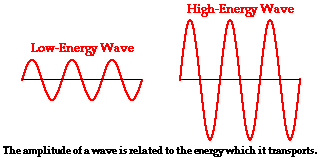
Example of Amplitude
Source: The Physics Classroom
Height, also known as amplitude controls the volume behind the tone. The louder the sound is, the higher the wave's height will be and the more force it will have behind it. Softer sounds are represented as expected, smaller wave height will be. This one is really as obvious as it sounds. Duration is the same way. Duration is the measurement of how long the sound can be heard and is a measurement of time.  The longer the wave is the longer the sound can be heard.


Example of Timbre
Source: Swasti's Design Blog


Finally there is the shape of the wave, known as timbre (pronounced tam-bur). Every instrument has its own timbre and also its own wave pattern. For example, a piano looks one way while a violin looks another. Every variation changes the way the music sounds to our ears. It’s just like taking a computer and running a “sine wave” or a traditional wave like U and n’s, a sawtooth wave (which as the name sounds, looks like the teeth of a saw or W’s) or a piano's wave pattern, which is shown to the right.

That's all for today, and I hope this style is easier to understand. Next time I'll pick up with why you should know these terms and how they apply to music. As always, if you haven't subscribed then please do by filling out the email link to the right (don't worry, it only emails you when there are new posts on here). If you already follow us then thank you as always and thanks for reading!

Thursday, April 11, 2013

Episode 1: What is Music? (based off the original episode "Musical Alphabet and Note Values")


Hey everyone, Sulli here with the "main series" 2.0! The video above is the new version of the old video. It goes into a little bit better detail of what music is, and starts us off where the original episode is. In case you want to see where we started from, this is the original episode from the series:

http://sulliadm.blogspot.com/2012/03/episode-1-musical-alphabet-and-note.html

Don't forget to follow the blog on Twitter, Facebook, and YouTube!

Facebook: http://www.facebook.com/sulliadm
Twitter: http://www.twitter.com/sulliadm
YouTube: http://www.youtube.com/ASMusicTheoryBlog