Showing posts with label basics. Show all posts

Tuesday, June 3, 2014

Music Theory 101 #6: The Basic Skills of Music; Dynamics

Hello everyone and welcome back to the next episode of Music Theory 101. Sorry about vanishing, but between the end of school, the trip/ meeting in Minneapolis and then getting two major plans set up (announcements ASAP) I literally had no time to keep working. This will be the end of the explanations and salutations though because we have a month’s worth of material to make up in this extended post!

Music Terms:

~Amplitude
~Dynamics
~Forte and Piano
~Mezzo
~Adding -issimo (fortissimo, pianissimo)
~Fortepiano and Pianoforte

Catching everyone back up to speed, we have gone through posting about the basics of music and have made our way through two of the six: Pitch and Rhythm. This time, we move onward to the next topic for discussion; dynamics. Dynamics are the musical equivalent to amplitude. For those in need of a quick refresher, amplitude is the expansion or contraction of the wave’s height causes the wave to have more or less force. This increase or decrease in power can cause our ears to perceive what we hear to be louder or softer. That’s honestly all there is to this one in terms of science and terminology. However, dynamics play a more important role in music.


Music’s emotional weight is primarily built off of dynamic control. It is true to the point of listening to movies. Think to the last movie you’ve seen and how the dynamics of the music played into each point that the scene was trying to make. For example, whenever there is a romantic scene and there is a couple talking, the music backs off but you can hear that they are playing. Once they start to kiss,  the music becomes really loud to show that emotion’s weight. The same can be argued for any kind of music. A classical example is “March of the Scaffolds” by Hector Berlioz. The beginning starts out low and quiet until the cellos and bass come in with the motif of the movement. Every time there is portrayed a horrifying moment or a moment of triumph in the movement then the horns play loud. Whenever the thought of his beloved come to him, then it is soft and tender. Modern music examples is the difference between a rock ballad and heavy metal. The difference between trance/chillstep and hard style/brostep. Dynamics control a lot in music.

Now that we know what it is and what they do, why not explain how they are in music. Before we begin however, it should be noted that they are very situational. None are defined by an absolute “loudness” like pitch and other things in music. Dynamics are based off their original words in Italian and use the first letter to represent the dynamic. Forte is considered to be “loud” and is shown by adding an italicized f. Piano is considered “soft” or quiet and is shown with an italicized p. Next thing to know about with dynamics is the mezzo range. Mezzo means medium and if it’s used as a prefix, it means either medium loud, mezzo forte or mf, or medium soft, mezzo piano or mp.

There are also extremes by adding more of each letter into the mix, getting fortissimo, ff and pianissimo, pp. When you add the -ssimo suffix; meaning very, you can create more extremes for your dynamic timeline. You can add more letters to mean more contrast, such as fffffffffff. Just be warned that the mentioning of relations of dynamics are meant to be taken. So don’t expect a cannon like sound from your instruments… Unless you use a cannon. The last thing related to dynamics I want to mention is the case of fortepianos. Fortepiano and it’s reverse pianoforte are used for extreme changes in dynamic that are meant to last temporarily. They are played as they are read. In the case of fortepianos, fp, they should be played loudly and then soft. The reverse is true for pianofortes, though they aren’t as commonly used.


There is one other dynamic term that I will go over during our next episode. I hope this extended post was worth the wait! Keep an eye out for announcements in the next day or two.

Sunday, April 20, 2014

Music Theory 101 #5: The Basic Skills of Music; Rhythm: Pt. 2

Hello everyone and welcome back to the Music Theory 101 series on ASMTB! I hate that last week was a dud but I had a lot going on I had to take care of (mostly pertaining to updating the site soon!) and posting sort of slipped my mind. I am really sorry about that, but I hope this episode and the updates will make up for this little mishap!

Today's lesson is to continue talking about rhythm in comparison to the six basics of music. If you would like to follow along with the previous ones then I made a tab above (If you're reading this from the newsletter then head on over and show us some love). As I mentioned in the last post, duration is the length a pitch is produced. I failed to bring up that it is not strictly related to pitches, but can measure rests as well. Rests are something that are not commonly mentioned because they are simpler than pitches, however they have an equal amount of importance compared relative to music. Music can be seen as a very carefully planned balance of sound and silence. Composers such as John Cage and Penderecki made sure that it was clear composers and musicians should know these differences. If you are interested in hearing these pieces, check out "4:33" by John Cage and "Threnody for the Victims of Hiroshima" by Penderecki. Both of them are earfuls for two different reasons! Digressing from modern music and back onto my last post, we see that I explained how music is divided counting wise and what the time signature is. Now we need to continue and explain more on these concepts.

Music Terms:

~Dotted Rhythm
~Simple & Compound Meter
~Tuplets (Triplets, Duplet, etc.)

Credit: Music-Mind.com
Music does not only divide two ways, but it is possible to divide it into more divisions. The first way is to use dotted rhythm. Dotted rhythms is when you add a dot after the note. The dot represents adding half of the original value to the note. So if you add a dot to a half note, then you have a half note PLUS another quarter note, making it equal to three quarter notes. Also, adding a dot after a whole note makes it a half note added onto the whole note. If you want to add more dots, then you add half of the last value. So a double dotted half note is one half note, PLUS a quarter note PLUS an eighth note. So you half three and a half quarter notes.

The uses of this makes it possible to have compound meters. The best way to explain compound meter is through actual examples. If we take a look at most music, one can feel music in a two or as in four. This is called simple meter. It is either feeling a beat, or pulse, as "one & two &" or something that can be subdivided into half. All of these include 2/4, 3/4, 4/4, or anything related to them. Compound meter comes into play for meters such as 6/8, or 12/8 where the beat is broken into 3. For a more classical and audible examples of this, listen to Mozart's "Eine Kleine Nachtmusik" compared to his "Jesu, Joy of Man's Desiring" (Click on the names to hear audio). Eine Kleine is in a simple meter because the division of the beat is in two, versus Jesu which is in 12/8 and is subdivided in three.

Credit: Scaletrainer.com
If you do not want to write a piece that is completely one way the entire time, you can use tuplets. Tuplets is the generic term used to define a rhythm in a different rhythmic subdivision. The most common example of these are triplets. Triplets are when you fit three notes in the space of two, such as fitting three quarter notes within a two quarter notes. The reverse is true as well, you can fit 2 notes in the space of 3. Using a duple, you can fit two notes within three. It is even possible to fit more in a space.

Before this drags on much longer, I'm going to wrap up rhythm here. Later on, I'll write a full post on polyrhythms and other cool things one can use rhythm for. For now however, this will be the end of this discussion and I'll start with the next topic of this series. Until then, this is Sulli signing off! 

Monday, February 17, 2014

Music Theory 101 #3: The Basic Skills of Music; Pitch Pt. 2

Hello everyone and welcome back to the Music Theory series on here. Before I begin, I would like to say thank you for all the reception and the help that was given towards helping me out with the site! It is not very apparent unless you run a project or a website to realize how much help there is when everyone submits feedback on it. From the bottom of my heart, I sincerely mean thank you. There was some things discussed that will cause a huge shift in this website within the near future, so stay tuned for that!

Key Terms:
Staff
Middle C
Treble Clef (G clef)
Bass Clef (F clef)
Grand Staff

As we were discussing last time, pitch is one of the six basic principles of a language. We have also discussed the basics of pitch as well from it's purpose to how it is heard and even broken it down into the 12 pitches on a keyboard. However, just so we can wrap this discussion up we need to go ahead and head from the basics that every musician knows and talk about the basic skill that every musician should know but do not. This is the staff and reading the clefs.

Blank staff lines from this site
First, we must look at what the staff is. The Music Staff is the space that musicians start when looking at music. It is a set of lines and spaces that musicians use to create notes. There are five (5) lines and four (4) spaces. As you go towards the top of the page, you go higher in pitch or heading towards the bottom of the page the lower you go. The notes themselves vary depending on which clef you are using.

In order to make sure that the following is extremely clear, we must find one point that defines each clef equally. For this, we are going to use "middle C" or the C that is in the middle of the piano. It is usually marked by the logo in the middle of the piano's cover but there are digital keyboards that note where it is. Something else I should bring up now is the statement of octave indicators (or Scientific Pitch Notation). This is how we figure out if a note is higher or lower without saying "this note is higher than" and so on. In the case of the previously stated "Middle C", it is identified as C4. The way I remember that middle C is C4 is thinking "Music starts at C and music is explosive!" (corny, but it works if you need something to use to learn). The way the indicators are meant to work as from C to B. So for example B3 is the B below middle C. For another example, let us look at D5. It is the D an octave above middle C. So instead of being the D directly above middle C, it is a note and an octave up.

This is a treble clef on a staff
Source: It's A Visual Medium
The clef is the first symbol on the staff. It defines where what note is on a staff, much like a a musical GPS coordinator. There are several dozen standardized clefs that are out there, and hundreds of non-standardized but  for this article, we will will talk about two specifically. The first clef we will look at is the Treble Clef, also known as the G clef. The reason for the name is the part that curls around the second to bottom line is noted as G. The space below that is an F, the line below that is E and so on. The space below the G is A, the line above that is B and so on. This G is known as G4 which means it is the G above middle C.
This is a bass clef on a staff
Source: Mr. Scheiber's Music Room

The other clef is the Bass Clef also known as the F clef. As with the previous, the reason for the second name is because the dots are placed around the note F. Also as before if you go down, you have E and D or up leads to G and A. Now, the thing to realize is this F is an F3, or the F below middle C.
This is a grand staff and note equivalents
Source: Click here

The final portion of this post will be about the grand staff and it's uses. The Grand Staff is the combination of the bass and treble clefs. It is used for piano, piano styled instruments and harp reading primarily but is used to condense scores down into an easier to read format. The reasoning is to create a larger range of pitches than any one can accomplish by themselves. It reads as if one large staff. The meet in the middle at middle C. Along with the additional space, there is an additional an bracket at the beginning to link them together. In the case of organ music, there would be three or possibly four staves but as I stated before this is primarily two. Next time we will start heading onto the next topic of discussion!

Monday, January 20, 2014

Music Theory 101 #1: The Basics of Sound

Hello everyone and welcome back to not only the newest episode on ASMTB but to the first episode of my new music theory lessons series.  As I had mentioned in the announcements post at the beginning of the month, I have been planning a lot of new changed from feedback I have received saying some things need to be simplified. Being a person who tends to over think things, I have been thinking of a way to do just that: simplify (I smell an oxymoron). This time around I will make theory less “dense” of reading than before in order to make sure you understand what I am trying to convey to whomever is reading this because let’s face it: Music theory can be hard to understand. It has a moment or two where you can look at it and it makes perfect sense, and then look again and our understanding has vanished completely. With that said, should I not explain something very well, then feel obligated to email me, Faith, or leave a comment below to see if someone else can help you. We want to help ensure that you get a well explained understanding of how theory should be, especially if you’re taking the time to read this. With that said, let’s continue onto the beginning of this discussion.

For time’s sake, I’m going to skip over a very detailed understanding of what sound is but basically sound is a type of energy that our ears pick up through the ear drum. Whenever we interpret sound energy, there is a wave of energy from a source that is picked up by our ears. This wave can be altered in four (4) ways: pitch, height, length and shape. These four things will play a big part into understanding music in a moment.

Example of Frequency
Source: TutorVista


Pitch; better known as frequency, is the variable that gives us the sound of the note you hear. For example, play a note on any instrument such as playing a key on a key board, plucking a string on a stringed instrument or hum a pitch.  Whatever that note is, it has a certain Hertz or number of wave cycles that go past a point per second. So if you take A 440 then it means there are 440 wave cycles going to your ear per second. By jumping down to C 262 or middle C then we have 262 wave cycles per second. Every note has it's own hertz and repeats as you go up or down a certain number of cycles. Though this is the most obvious part to music, this will play a big role in understanding music.


Example of Amplitude
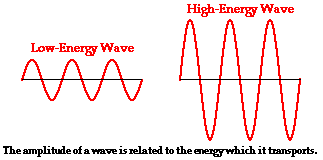
Source: The Physics Classroom
Height, also known as amplitude controls the volume behind the tone. The louder the sound is, the higher the wave's height will be and the more force it will have behind it. Softer sounds are represented as expected, smaller wave height will be. This one is really as obvious as it sounds. Duration is the same way. Duration is the measurement of how long the sound can be heard and is a measurement of time.  The longer the wave is the longer the sound can be heard.


Example of Timbre
Source: Swasti's Design Blog


Finally there is the shape of the wave, known as timbre (pronounced tam-bur). Every instrument has its own timbre and also its own wave pattern. For example, a piano looks one way while a violin looks another. Every variation changes the way the music sounds to our ears. It’s just like taking a computer and running a “sine wave” or a traditional wave like U and n’s, a sawtooth wave (which as the name sounds, looks like the teeth of a saw or W’s) or a piano's wave pattern, which is shown to the right.

That's all for today, and I hope this style is easier to understand. Next time I'll pick up with why you should know these terms and how they apply to music. As always, if you haven't subscribed then please do by filling out the email link to the right (don't worry, it only emails you when there are new posts on here). If you already follow us then thank you as always and thanks for reading!